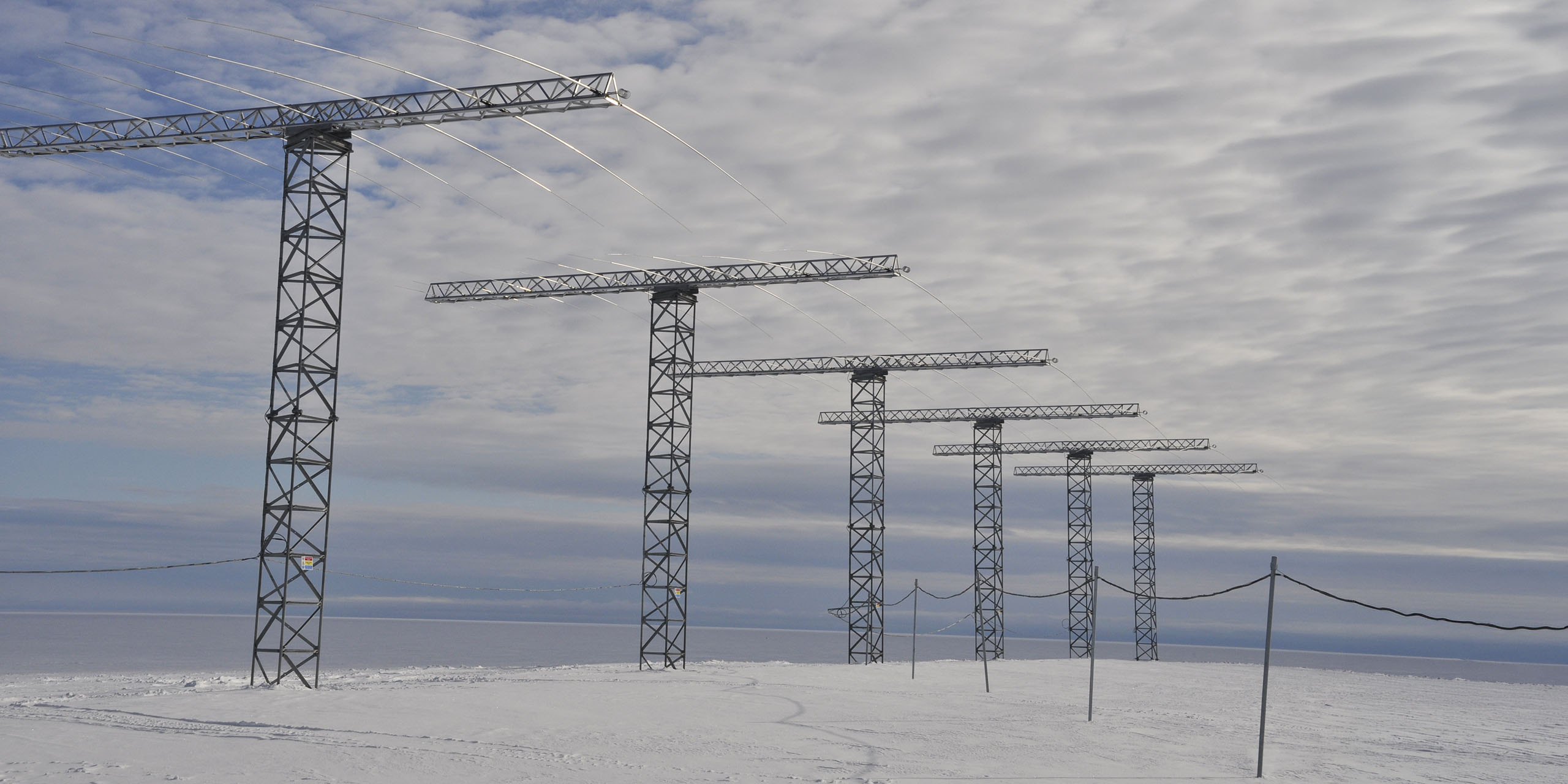
Ionospheric vorticity across the northern hemisphere ionosphere determined from SuperDARN radar pairs - 2011 to 2016 inclusive.
GB/NERC/BAS/PDC/02210
Page Links
Jump To:
- Citation
- Access Data
- Constraints
- Basic Information
- Additional Information
- Locality
- Instrumentation
- Storage
Related Links
Summary
Abstract:
The data set comprises ionospheric vorticity estimates determined from measurements of ionospheric velocity made by overlapping pairs of northern hemisphere radars in the Super Dual Auroral Radar Network (SuperDARN) (Chisham et al., 2007). The vorticity estimates are separated into data files for each pair of SuperDARN radars that contributed to the whole data set. These data cover large regions of the northern hemisphere polar ionosphere, and the locations of the vorticity estimates are presented in both geographic and Altitude-Adjusted Corrected GeoMagnetic (AACGM) co-ordinates. The data cover the interval from 2011 to 2016 inclusive.
Keywords:
SuperDARN, ionosphere, vorticity
Citation
Chisham, G., Ruohoniemi, J.M, Bristow, W.A, Hussey, G.C, & Shepherd, S.G (2026). Ionospheric vorticity across the northern hemisphere ionosphere determined from SuperDARN radar pairs - 2011 to 2016 inclusive. (Version 1.0) [Data set]. NERC EDS UK Polar Data Centre. https://doi.org/10.5285/c45ba223-ea6d-4c52-a6c5-3b89a4278cad
Access Data
GET DATA
PROJECT HOME PAGE
- https://superdarn.ca
- https://superdarn.thayer.dartmouth.edu
- https://vt.superdarn.org
- https://www.bas.ac.uk/project/superdarn/
REFERENCE MATERIALS
- https://doi.org/10.1007/s10712-007-9017-8
- https://doi.org/10.1029/2009JA014263
- https://doi.org/10.5194/angeo-26-823-2008
RELATED DATA SET METADATA
Constraints
| Access Constraints: | None |
|---|---|
| Use Constraints: | None |
Basic Information
| Creation Date: | 2026-05-20 |
|---|---|
| Dataset Progress: | Complete |
| Dataset Language: | English |
| ISO Topic Categories: |
|
| Parameters: |
|
| Personnel: | |
| Name | Dr Gareth Chisham |
| Role(s) | Metadata Author, Investigator |
| Organisation | British Antarctic Survey |
| Name | Dr J Michael Ruohoniemi |
| Role(s) | Investigator |
| Organisation | Virginia Tech. |
| Name | Dr William A Bristow |
| Role(s) | Investigator |
| Name | Dr Glenn C Hussey |
| Role(s) | Investigator |
| Organisation | University of Saskatchewan |
| Name | Dr Simon G Shepherd |
| Role(s) | Investigator |
| Organisation | Dartmouth College |
| Parent Dataset: | N/A |
Additional Information
| Reference: | Chisham et al. (2009), Spatial distribution of average vorticity in the high-latitude ionosphere and its variation with interplanetary magnetic field direction and season, J. Geophys. Res., 114, A09301, doi:10.1029/2009JA014263. Chisham et al. (2007), A decade of the Super Dual Auroral Radar Network (SuperDARN): scientific achievements, new techniques and future directions, Surv. Geophys., 28, 33-109, doi:10.1007/s10712-007-9017-8 Chisham et al. (2008), Mapping ionospheric backscatter measured by the SuperDARN HF radars - Part 1 - A new empirical virtual height model, Ann. Geophys., 26, 823-841, doi:10.5194/angeo-26-823-2008. |
|
|---|---|---|
| Quality: | The overall quality of the vorticity estimates is highly dependent on the raw SuperDARN velocity data that provide the primary data source. These are generally of high quality with low errors. The quality of the vorticity estimates is mostly affected by missing velocity data around the closed loops. To mitigate this, the vorticity estimates are only determined when adequate SuperDARN velocity data covering all sides of the closed loop are available. See Chisham et al. (2009) for full details regarding data quality. | |
| Lineage/Methodology: | The vorticity estimates are determined by taking SuperDARN line-of-sight velocity measurements of the ionospheric plasma flow around spatially closed loops determined by the geometry of the SuperDARN beam look directions. The vorticity at the centre of these closed loops is determined by summing the flow velocity around the loops, and dividing by the area, using Stokes' theorem. The ionospheric vorticity determination methodology is outlined in detail in Chisham et al. (2009), and the data are geolocated using the virtual height model of Chisham et al. (2008). Data structure and data format: There are 4 files, all in a space-delimited ASCII format, with a combined size of ~3.2 GB. The data files are fhw_cve_vort_2011_2016.txt, kap_sas_vort_2011_2016.txt, pgr_kod_vort_2011_2016.txt, rkn_inv_vort_2011_2016.txt. The first two strings in the filename gives the codes of the two overlapping SuperDARN radars used for that data file: fhw : Fort Hays West; cve : Christmas Valley East; kap : Kapuskasing; sas : Saskatoon; pgr : Prince George; kod : Kodiak; rkn : Rankin Inlet; inv : Inuvik. The 'vort' in the filename represents vorticity, and the trailing numbers represent the start (2011) and end (2016) years of the data sets. Each data file has the following format: Header. (Followed by a series of data records of the form?) Year, Month, Day, Decimal Hour Number (Followed by Number x 3 line records, where the first line is of the form...) r1_b1, r1_b2, r2_b1, r2_b2, Area, Vorticity, MLT (where r1_b1 : The first beam from radar 1 used to form the closed loop for analysis. r1_b2 : The second beam from radar 1 used to form the closed loop for analysis. r2_b1 : The first beam from radar 2 used to form the closed loop for analysis. r2_b2 : The second beam from radar 2 used to form the closed loop for analysis. Area : The area within the closed loop, in km^2. Vorticity : The measured vorticity in Hz ; When analysing it is recommended to multiply vorticity values by a value of 1000 to retrieve the vorticity in mHz. MLT : Magnetic Local Time, in hours.) (And the second and third lines are of the form) coord_index, lat_c, long_c, lat_1, long_1, lat_2, long_2, lat_3, long_3, lat_4, long_4 (where: coord_index : This index is 0 for geographic co-ordinates and 1 for AACGM co-ordinates. lat_c, long_c : The co-ordinates of the centre of the diamond that defines the closed loop. lat_1, long_1,.., lat_4, long_4 : The co-ordinates of the four vertices of the diamond that defines the closed loop.) |
|
Locality
| Temporal Coverage: | |
|---|---|
| Start Date | 2011-01-01 |
| End Date | 2016-12-31 |
| Spatial Coverage: | |
| Latitude | |
| Southernmost | 40 |
| Northernmost | 90 |
| Longitude | |
| Westernmost | 180 |
| Easternmost | 0 |
| Altitude | |
| Min Altitude | 200 Km |
| Max Altitude | 400 Km |
| Depth | |
| Min Depth | N/A |
| Max Depth | N/A |
| Location: | |
| Location | Northern Hemisphere |
| Detailed Location | N/A |
Instrumentation
| Data Collection: | The data set comprises vorticity estimates from the following overlapping pairs of SuperDARN radars: (1) Kodiak (KOD) and Prince George (PGR); (2) Saskatoon (SAS) and Kapuskasing (KAP); (3) Rankin Inlet (RKN) and Inuvik (INV); (4) Fort Hays West (FHW) and Christmas Valley East (CVE). The SuperDARN line-of-sight velocity data were estimated using the FitACF v2.5 algorithm as part of the SuperDARN Radar Software Toolkit (RST) v4.5. The data were geolocation mapped using the Chisham et al. (2008) virtual height model. The vorticity locations are presented in both geographic and AACGM co-ordinates. |
|---|